Thanos
ACTIVE
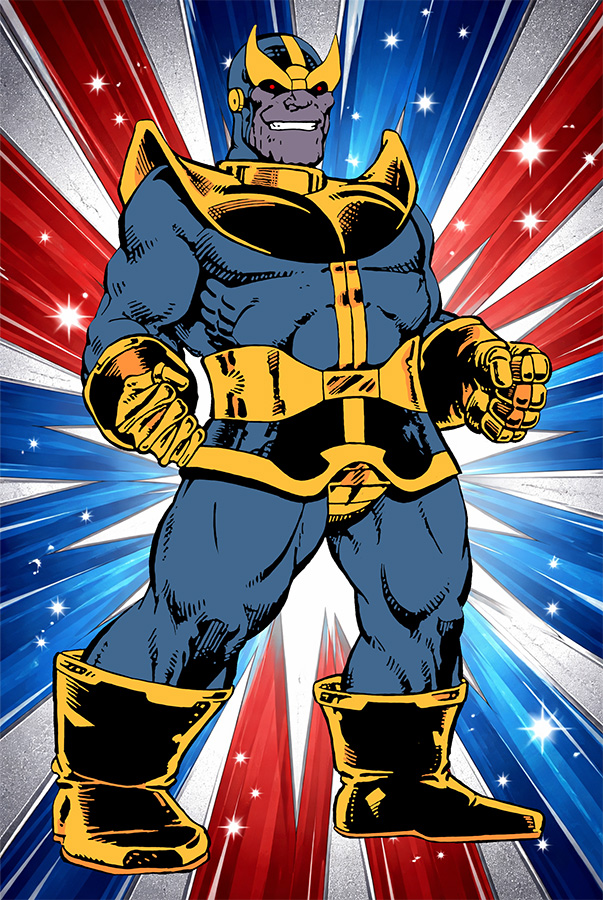
- Known Aliases: Mad Titan, Prime Eternal, Overmaster
- Identity: His existence is unknown to the general populace of Earth, but known to the peoples of many other civilizations throughout the galaxy.
- Occupation: Conqueror, worshipper of Death
- Legal Status: Citizen of Titan
- Place of Birth: Mobile; formerly Titan; Sanctuary II; Necropolis, Wakanda, Earth; Black Quadrant; Chitauri Prime; Unnamed farm planet
- Marital Status: Single
- Known Relatives: A'lars (Mentor, father), Sui-San (mother), Eros (Starfox, brother), Zuras (uncle, deceased), Thena (niece), Gramora and Nebula (foster daughters)
- Group Affiliation: Eternasls of Earth
- Base of Operations: Mobile; formerly Titan, Sanctuary II
- Education: Combination of formal Titanian education and self-teaching
- Species: Titan
- Gender: Male
- Height: 6 ft. 7 in.
- Weight: 985 lbs.
- Eyes: Red
- Hair: None
- Skin: Grey-purple
- Other Distinguishing Features: Furrowed chin
Thanos was one of the last sons of A'lars, progenitor of the second colony of Eternals of Titan, and Sui-San, the last survivor of the original settlement of Eternals on Titan. Born with grey, hide-like skin and a massive body due to a Deviant genetic syndrome, Thanos was a morose child who became fascinated with the concept of death. His grim disposition and philosophical curiosity about mortality set him apart from the other Titanian Eternals. Over time he augmented his natural Eternal physiology through bionic enhancements, scientific experimentation, and intense meditation, increasing his already formidable strength and abilities far beyond those of his kin.
As Thanos matured, his fascination with death transformed into a nihilistic worldview. Convinced that life itself was inherently meaningless, he began seeking power and conquest as a means to impose his philosophy upon the universe. He eventually stole a Titanian starship and traveled across multiple star systems, recruiting soldiers, mercenaries, and malcontents to form a private army. With a small but devastating fleet at his command, Thanos returned to Titan and unleashed nuclear devastation upon his own world, slaughtering thousands—including his own mother. With Titan shattered and depopulated, Thanos declared himself its ruler before turning his ambitions outward toward the stars.
Expand full history
At some point in his adult life, Thanos encountered the cosmic embodiment known as Death. Appearing before him in female form, Death became the object of Thanos’s obsessive devotion. Interpreting his attraction to her as love, Thanos resolved to prove his worth by committing acts of destruction on a universal scale. His first major campaign toward that goal involved obtaining a reality-altering artifact known as the Cosmic Cube. Using the Cube, Thanos briefly achieved godlike power and attempted to dominate the universe. However, his plan brought him into conflict with Earth’s heroes and the Kree champion Captain Marvel. In the ensuing battle Thanos was ultimately defeated, losing the Cube’s power when his enemies turned it against him.
Undeterred, Thanos resumed his quest to demonstrate his devotion to Death. His schemes soon drew him into conflict with the cosmic hero Adam Warlock. Seeking to offer Death the ultimate tribute, Thanos devised a plan to extinguish the stars of the universe one by one. He manipulated events across time and space in order to eliminate the future tyrant known as the Magus, a dark future incarnation of Warlock, while simultaneously drawing power from Warlock’s own Soul Gem. Thanos constructed a massive synthetic device capable of channeling the energies of multiple Soul Gems and began initiating stellar destruction. Warlock, aided by Earth’s heroes, ultimately confronted the Mad Titan. Though Warlock himself died in the battle, his spirit later returned imbued with cosmic power and transformed Thanos into living stone, leaving him conscious yet immobilized.
Thanos remained trapped in this state until he was resurrected by Death herself. Believing that the universe had become imbalanced by the growth of life, Death commanded Thanos to eliminate half of all living beings. To accomplish this task, Thanos began searching for six primordial artifacts known as the Infinity Gems. Through cunning, manipulation, and overwhelming force, he succeeded in acquiring them all and mounted them within a cosmic artifact called the Infinity Gauntlet.
With the completed Gauntlet, Thanos attained nearly absolute control over reality. In a single act he erased half the life in the universe, fulfilling Death’s command. His newfound omnipotence drew the attention of Earth’s greatest heroes as well as cosmic beings representing fundamental aspects of reality. Despite possessing power rivaling the abstract entities themselves, Thanos ultimately lost the Gauntlet due to his own subconscious desire for failure. Adam Warlock and his allies reclaimed the artifact and restored the universe to its proper state, leaving Thanos exiled and stripped of his godlike power.
Despite this defeat, Thanos continued to influence cosmic events. When the Magus returned, threatening reality with an army of twisted duplicates, Thanos reluctantly allied himself with Warlock and other heroes to prevent universal destruction. Shortly afterward, they faced another manifestation of Warlock’s psyche—the being known as the Goddess—whose misguided quest to purge evil from the universe threatened to annihilate entire civilizations. In both conflicts, Thanos demonstrated a willingness to oppose forces that might destroy reality itself, though his motivations remained deeply self-serving.
In later years Thanos wandered the cosmos in search of knowledge, power, and worthy adversaries. At times he allied with heroes when greater threats emerged, including cosmic wars that endangered the structure of the universe. During a massive intergalactic conflict involving the insectoid conqueror Annihilus, Thanos became a pivotal figure in the struggle for survival across multiple galaxies. That war ultimately ended with Thanos’s apparent death.
As had happened before, death did not hold him for long. Thanos later returned during a catastrophic conflict involving a twisted universe known as the Cancerverse. The destructive nature of that realm threatened to overwhelm reality itself, and in the final confrontation Thanos sacrificed himself to help seal the Cancerverse away from the main universe.
Even that sacrifice did not permanently end the Mad Titan’s existence. Thanos eventually returned once more, launching a devastating invasion of Earth in pursuit of a hidden heir he had secretly fathered. His assault brought him into direct conflict with the Avengers and numerous cosmic defenders, who ultimately succeeded in defeating and imprisoning him. Yet the collapse of the multiverse soon afterward allowed Thanos to escape captivity and resume his schemes.
Not long afterward he was confronted and killed by his long-time nemesis Drax the Destroyer. True to pattern, however, Thanos returned again through advanced cloning techniques. During this period he encountered a future incarnation of himself known as King Thanos, a tyrant who had succeeded in exterminating nearly all life in the universe. The encounter offered Thanos a vision of the ultimate culmination of his philosophy: a universe reduced to silence.
Despite countless defeats, deaths, and resurrections, Thanos has never abandoned his pursuit of cosmic power or his devotion to Death. Whether as conqueror, manipulator, reluctant ally, or existential threat, the Mad Titan continues to shape events across the universe. His relentless nihilism, immense intellect, and near-limitless resources ensure that he remains one of the most dangerous beings in existence—an eternal adversary to the forces that struggle to preserve life itself.
Strength Level: The exact extent of Thanos's physical strength is not known, but he was able to engage both the Thing and Thor in hand-to-hand combat simultaneously for an extended period of time and held his own. Presumably, then, Thanos possessed at least Class 100 strength, enabling him to lift (press) over 100 tons.
Known Superhuman Powers: Thanos possessed incalculable superhuman power. By far the most powerful of the Titanian Eternals, Thanos was a mutant whose massive, heavy-bided body was born with the capacity to synthesize cosmic energy for certain personal uses. (This is a trait that Thanos shared with his father A'lars and all Earthborn Eternals but not with Titan-born Eternals. Through still unknown bionic amplification, Thanos increased his physical strength and resilience to levels surpassing even the strongest of the Earth Eternals. Through meditation and certain mystical techniques, Thanos augmented his power in still other ways, enabling him to tap, transform, and direct vast quantities of cosmic energy for destructive force. His skin in nearly invulnerable, particularly against heat, cold, electricity, radiation, toxins, aging, and disease, and he can survive indefinitely without food or water even before his "curse" from Death left him immortal, unable to die. His mind is also invulnerable to most forms of psychic attack, and can project a psionic blast of energy as well as blasts of plasma/cosmic energy from his eyes and hands. Deadliest of all Thanos's attributes, perhaps, is his mind, whose superhuman level of intellect was totally dedicated to the annihilation of life.
Thanos has employed a wide range of weapons, artifacts, and technological equipment over the course of his career as a cosmic warlord. Although his immense strength, durability, and cosmic energy manipulation often make conventional weapons unnecessary, he frequently utilizes powerful devices, starships, and cosmic relics when pursuing large-scale conquest or universal power.
One of the most significant artifacts Thanos has ever wielded is the Infinity Gauntlet, a specialized device designed to house the six Infinity Gems. Each gem embodies a fundamental aspect of reality—power, space, time, mind, soul, and reality. When Thanos succeeded in assembling all six and mounting them within the Gauntlet, he gained nearly absolute control over the universe. With a single act he was able to erase half of all living beings, manipulate time and space at will, and confront cosmic entities that normally exist far beyond mortal power.
Expand full description
Prior to obtaining the Infinity Gems, Thanos had already demonstrated the destructive potential of another powerful artifact known as the Cosmic Cube. The Cube is a reality-altering device capable of granting godlike abilities to its wielder. When Thanos briefly controlled such a device, he transformed himself into an immensely powerful cosmic being able to manipulate matter, energy, and the fabric of reality. Although he ultimately lost the Cube’s power, the event demonstrated the scale of power Thanos was willing to harness in pursuit of his goals.
Thanos has also employed devices designed to manipulate the energies of the Infinity Gems themselves. During one of his early schemes to destroy the universe’s stars, he constructed a massive synthetic power system capable of channeling the energy of multiple Soul Gems into stellar bodies. By directing those energies into stars, Thanos could cause them to explode as novas, gradually extinguishing all life in the universe.
Much of Thanos’s military strength comes from his command of advanced starships and war fleets. His flagship, Sanctuary II, serves as both a mobile fortress and a command vessel. The ship contains powerful energy cannons, planetary bombardment weapons, teleportation systems, and large hangars for troop deployment. Sanctuary II allows Thanos to wage interstellar warfare and project power across entire star systems while coordinating the movements of his armies.
As the son of the Eternal scientist A'lars, Thanos is also a master engineer who frequently uses advanced Titanian and alien technology. He has built or utilized a variety of experimental devices, including energy siphons capable of draining cosmic power, teleportation technology for rapid interstellar movement, and machinery capable of manipulating or harvesting stellar energy. His armor itself often contains technological enhancements such as energy amplification systems, force-field generators, environmental protection, and tactical sensors.
Although far less common, Thanos has occasionally used handheld weapons in combat situations. These include alien energy rifles, bladed weapons, and other advanced armaments typically far more powerful than conventional human weaponry. Such weapons are generally used when leading troops or confronting particularly dangerous opponents, though Thanos usually prefers to rely on his own immense physical strength and cosmic energy projection in battle.
Finally, Thanos has sought out powerful sources of knowledge and cosmic power as tools in their own right. Among these was the Oracle, a vast repository of universal knowledge that he pursued in order to uncover new information about powerful beings and potential adversaries. For Thanos, knowledge itself is often treated as a weapon, providing strategic advantage and revealing opportunities to acquire even greater power.
Taken together, Thanos’s arsenal is less a collection of personal weapons than a combination of cosmic artifacts, advanced technology, and military resources. Whether wielding the reality-altering Infinity Gauntlet, commanding the devastating firepower of Sanctuary II, or designing machines capable of manipulating stellar energies, Thanos consistently employs whatever tools are necessary to extend his influence across the universe.
- First appearance (Iron Man #55, 1973)
- First full confrontation with Captain Marvel begins (Captain Marvel #25, 1973)
- Attempt to destroy the universe using the Cosmic Cube (Captain Marvel #29, 1973)
- First defeat and apparent death at the hands of Captain Marvel (Captain Marvel #33, 1974)
- Return in the Warlock saga involving Adam Warlock (Strange Tales #178, 1975)
- Attempt to destroy all stars to impress Death (Warlock #10, 1975)
- Turned to stone by Adam Warlock (Marvel Two-in-One Annual #2, 1977)
- Major Avengers/Warlock battle in the Thanos War (Avengers Annual #7, 1977)
- Resurrection manipulated by Death (Silver Surfer Vol. 3 #34, 1990)
- Begins collecting the Infinity Gems (Thanos Quest #1, 1990)
- Acquires the completed Infinity Gauntlet (The Infinity Gauntlet #1, 1991)
- Erases half of all life in the universe (The Infinity Gauntlet #1, 1991)
- Defeated by heroes and cosmic entities led by Adam Warlock (The Infinity Gauntlet #6, 1991)
- Magus returns in the Infinity War (The Infinity War #1, 1992)
- Battle against the Goddess during Infinity Crusade (The Infinity Crusade #1, 1993)
- Temporary alliance with heroes against cosmic threats (Thor #25, 2000)
- Major philosophical arc examining his nihilism (Thanos Vol. 1 #1, 2003)
- Captured and tortured by Annihilus during the Annihilation War (Annihilation #1, 2006)
- Death of Thanos during the Annihilation conflict (Annihilation #6, 2007)
- Resurrection and conflict with the Cancerverse (The Thanos Imperative #1, 2010)
- Sacrifices himself to seal the Cancerverse (The Thanos Imperative #6, 2010)
- Returns and attacks Earth searching for his son (Infinity #1, 2013)
- Battle against the Avengers and the Illuminati (Infinity #6, 2014)
- Captured by the Illuminati (New Avengers Vol. 3 #24, 2015)
- Escapes during the multiversal collapse (Secret Wars #1, 2015)
- Defeated and killed by Drax the Destroyer (Thanos Vol. 2 #1, 2016)
- Resurrected through a cloning process (Thanos Vol. 2 #5, 2017)
- Encounters his future self “King Thanos” (Thanos Vol. 2 #13, 2017)
- Death of Thanos in the future timeline (Thanos Vol. 2 #18, 2018)
- Return to power in modern cosmic conflicts (Guardians of the Galaxy #1, 2019)