Cat-Man (I)
Townshend Horgan
DECEASED
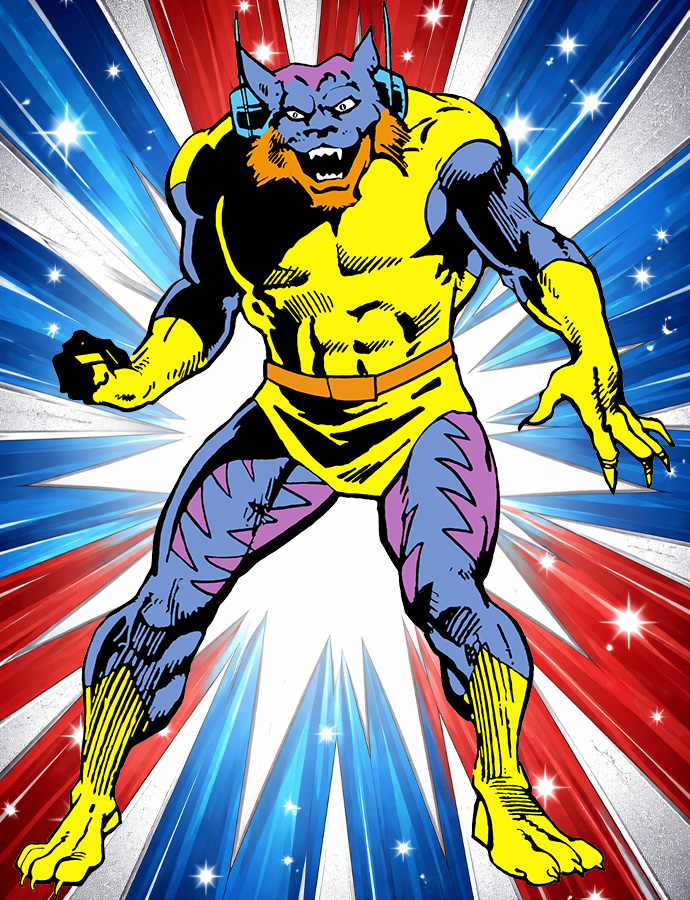
- Known Aliases: None
- Identity: Publicly known
- Occupation: Professional criminal
- Place of Birth: Unrevealed
- Legal Status: Citizen of the United States with a criminal record
- Marital Status: Unknown
- Known Relatives: None
- Group Affiliation: Ani-Men
- Base of Operation: New York City
- Education: Unrevealed
- Species: Human (Mutate)
- Gender: Male
- Height: 5 ft. 11 in.
- Weight: 185 lbs.
- Eyes: Green
- Hair: Brown
- Other Distinguishing Features: For a time Cat-Man I possessed razorsharp claws that were actually part of his body and were given him by scientist employed by Count Nefaria.
Townshend Horgan was not the architect of grand criminal schemes, nor the kind of man who sought power through transformation or invention. He was, instead, a professional opportunist—a man who understood that survival in the criminal world often depended less on brilliance and more on attaching oneself to the right operation at the right time. When he became Cat-Man, it was not out of obsession or ideology, but because the role existed and he was willing to fill it.
Horgan first emerged as part of the criminal enterprise orchestrated by the Organizer, who assembled the Ani-Men as a coordinated team of animal-themed operatives. Alongside Ape-Man, Bird-Man, and Frog-Man, Cat-Man served as one of the group’s core members. His identity was defined by agility, stealth, and close-quarters combat, fitting the predatory image the Organizer intended to project. Unlike some of his teammates, Horgan showed a degree of initiative and competence, often acting decisively in the field rather than simply following orders.
Expand full history
The Ani-Men were deployed against Daredevil, who had become a recurring obstacle to the Organizer’s plans. Their operations escalated quickly—from framing Daredevil for robbery to orchestrating kidnappings meant to manipulate events from behind the scenes. Horgan participated directly in these missions, operating as both an enforcer and an active agent within the group’s schemes.
During one such operation, the Ani-Men attempted to kidnap Debbie Harris, a plan that collapsed under Daredevil’s intervention. In the ensuing conflict, Horgan was captured. This moment revealed the true nature of the organization he served. To the Organizer, loyalty was irrelevant compared to secrecy. With Cat-Man in custody, the risk of exposure became unacceptable.
Gordon Keefer, the Ape-Man, was sent to silence him.
The decision was cold and calculated—Horgan was no longer an asset, but a liability. Keefer’s mission to assassinate Cat-Man before he could reveal anything underscored how expendable the Ani-Men truly were. Horgan survived the attempt, but the message was clear: within this hierarchy, even core members could be eliminated without hesitation. Ultimately, Daredevil defeated the Ani-Men once more, and Horgan was returned to prison alongside his teammates.
Like the others, imprisonment did not mark the end of his activities. Horgan later escaped and rejoined Bird-Man and Ape-Man, forming a new iteration of the group under a different name: the Unholy Three. Now working for the Exterminator, the trio resumed their pattern of organized criminal activity. The change in leadership brought a shift in direction, but not in outcome. They once again crossed paths with Daredevil, and once again, they were defeated.
Their continued operations brought them into conflict beyond Hell’s Kitchen. As the Unholy Three, they encountered both Daredevil and Spider-Man. Horgan, consistent in his role, relied on speed, aggression, and teamwork, but these qualities were not enough to overcome opponents accustomed to far more formidable threats. The group was defeated again, reinforcing a pattern that had followed Horgan since his earliest days as Cat-Man.
Despite repeated failures, Horgan remained part of the Ani-Men’s evolving legacy. When the group later entered the service of Count Nefaria, they underwent a transformation that finally granted them genuine superhuman abilities. For Horgan, this meant enhanced physical attributes aligned with his Cat-Man persona—greater agility, strength, and combat effectiveness. For the first time, he was more than a costumed criminal; he was physically capable of matching the image he projected.
Yet, as with the rest of the team, this power was not permanent. By the time of their final operation, the enhancements had failed or been lost. Horgan was once again a man relying on skill and experience rather than superhuman ability.
Still operating under Nefaria’s command, the Ani-Men were drawn into a conflict involving Iron Man. But their end did not come at the hands of a hero. Instead, it came from within the same criminal world that had shaped their entire existence.
The Spymaster, pursuing his own objectives, planted an explosive device within Nefaria’s base. When it detonated, it destroyed the stronghold entirely. Horgan, along with the original Ani-Men, was killed in the blast.
Townshend Horgan’s life as Cat-Man followed a consistent trajectory: recruited into something larger than himself, used as part of coordinated criminal efforts, repeatedly defeated, and ultimately discarded by the very systems he operated within. He adapted to new leaders and new identities—the Ani-Men, the Unholy Three, Nefaria’s enhanced operatives—but he never escaped the role he had accepted.
In the end, Cat-Man was not undone by a single enemy or a single mistake. He was undone by the nature of the world he chose to inhabit—a world where loyalty was conditional, power was temporary, and survival was never guaranteed.
Townshend Horgan survived most of his life without ever needing superhuman power—only speed, instinct, and a willingness to act faster than the people around him.
As Cat-Man, he built his reputation not on strength, but on movement. He fought like a predator in motion—circling, striking quickly, then repositioning before his opponent could respond. In his clashes with Daredevil, that style made him dangerous, but never dominant. Everything he did—every leap, every dodge, every attack—was grounded in peak human ability. He wasn’t enhanced, just highly capable, relying on reflexes and experience rather than brute force.
Full details
That remained true through most of his career, across the Ani-Men and the Unholy Three. He endured not because he was the strongest, but because he was adaptable.
Only once did that change. Under Count Nefaria, Horgan was temporarily granted real superhuman ability. His speed and reflexes surpassed human limits, his movements becoming sharper and more fluid, his strikes carrying greater force. For the first time, Cat-Man wasn’t just a name—it was something physical, something real.
But the power was never his to keep. It faded, leaving him exactly where he had always been: a skilled but ordinary man. In the end, Horgan didn’t lose his powers so much as return to his baseline—relying once again on the same instincts that had defined him from the beginning.
Cat-Man was never truly about superhuman ability. It was about how fast a man could think, move, and survive—and for most of his life, that was enough.
Cat-Man did not normally use weapons or paraphernalia.
- First appearance as Cat-Man / member of the Ani-Men (Avengers Vol. 1 #12, 1965)
- Joins the Organizer’s Ani-Men; first battle with Daredevil (Daredevil Vol. 1 #10, 1965)
- Frames Daredevil and participates in kidnapping plot (Daredevil Vol. 1 #11, 1965)
- Targeted for assassination by Ape-Man to protect the Organizer’s secrets (Daredevil Vol. 1 #12, 1965)
- Escapes prison; reforms as part of the Unholy Three (Daredevil Vol. 1 #39, 1968)
- Battles Daredevil as the Unholy Three (Daredevil Vol. 1 #40, 1968)
- Battles Daredevil and Spider-Man as the Unholy Three (Marvel Team-Up Vol. 1 #39, 1975)
- Gains superhuman powers under Count Nefaria (Iron Man Vol. 1 #115, 1979)
- Final appearance and death in explosion at Nefaria’s base (Iron Man Vol. 1 #116, 1979)