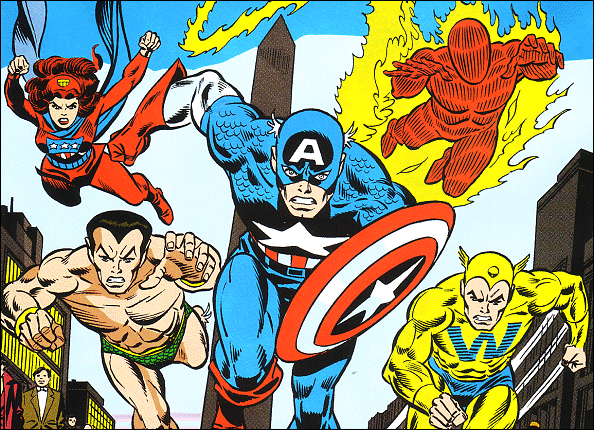
All-Winners Squad
Earth-616
Defunct
The All-Winners Squad was one of the earliest super hero teams in Marvel history, an informal wartime alliance of costumed champions assembled during the final years of World War II. Though never organized with the permanence or institutional structure of later teams such as the Avengers, the group united several of the era's most prominent heroes in response to threats too large for any one of them to handle alone. Later continuity established that the team’s wartime Captain America and Bucky were not Steve Rogers and James Buchanan Barnes, but Captain America (II), William Nasland, Captain America (III), Jeffrey Mace, and Bucky (II), Fred Davis.
Expand full history
The All-Winners Squad emerged in the closing phase of World War II, when the scale of global conflict encouraged previously independent heroes to cooperate more directly. Its ranks included Captain America (II), later Captain America (III), Bucky (II), Namor the Sub-Mariner, the original Human Torch, Toro, Miss America, and the Whizzer. Each member brought a distinct background and set of abilities, ranging from patriotic combat heroics to Atlantean might and synthetic firepower, giving the team a flexibility uncommon even among later super hero groups.
Although Golden Age stories originally presented the group as a straightforward team-up of Marvel’s wartime stars, later retcons significantly altered the identities of some of its best-known members. In modern continuity, Steve Rogers had already been lost near the end of the war, and James Buchanan Barnes was no longer serving as Bucky. Their places in the All-Winners Squad were instead filled by William Nasland and later Jeffrey Mace as successive Captain Americas, with Fred Davis operating as Bucky. This retroactive adjustment placed the team in a unique historical position, preserving its published adventures while integrating them more fully into postwar Marvel continuity.
The All-Winners Squad’s adventures pitted them against Axis threats, criminal conspiracies, and assorted superhuman menaces that arose in the unstable aftermath of the war. Like many early teams, they were less a standing organization than a coalition formed when circumstances demanded it. Their effectiveness rested not on bureaucracy or permanent headquarters, but on the willingness of powerful and often strong-willed individuals to set aside personal agendas for a common cause.
The presence of both Namor and the Human Torch on the roster also reflected the unusual alliances of the era. These heroes, who were sometimes difficult allies at best, nevertheless fought beside one another when the stakes justified cooperation. Miss America and the Whizzer added further breadth to the team, giving the All-Winners Squad a mix of patriotic symbolism, raw power, and wartime celebrity that made it one of the defining heroic assemblages of its time.
Despite its significance, the group did not survive long into the postwar world. As the immediate pressures of wartime receded, the need for such an alliance diminished, and its members returned to their individual paths. Some identities were lost, some heroes faded from public prominence, and others continued on in different contexts. This gradual dissolution left the All-Winners Squad as a brief but historically important chapter rather than an enduring institution.
In later years, Marvel revisited the team through flashbacks, retcons, and handbook material that expanded its place in continuity. These later treatments emphasized the All-Winners Squad as a forerunner to modern super hero teams, a prototype for the concept that exceptional individuals could accomplish more together than apart. While short-lived, the team occupies an important place in Marvel history as one of the earliest examples of the shared-universe team dynamic that would later define much of the line.
The All-Winners Squad therefore stands not merely as a nostalgic Golden Age curiosity, but as a foundational heroic alliance whose legacy stretches forward into the formation of later teams and the refinement of Marvel’s wartime mythology. Its roster, especially once clarified by later continuity, illustrates how mantles, identities, and historical memory evolved within the Marvel Universe long after the original stories were published.
- Base of Operations: Mobile; wartime operations across multiple theaters
- Affiliation: Allied cause; informal wartime alliance
- Founder(s): Informal wartime alliance
- Status: Defunct
- Current Member(s): None
- Former Member(s): Captain America (II), Captain America (III), Bucky (II), Namor the Sub-Mariner, Human Torch, Toro, Miss America, Whizzer
- First Appearance (All Winners Comics #19, 1946)
- Formation of the Team (All Winners Comics #19, 1946)
- Battles During World War II (All Winners Comics #19-21, 1946-1947)
- Final Mission of the Team (All Winners Comics #21, 1947)